
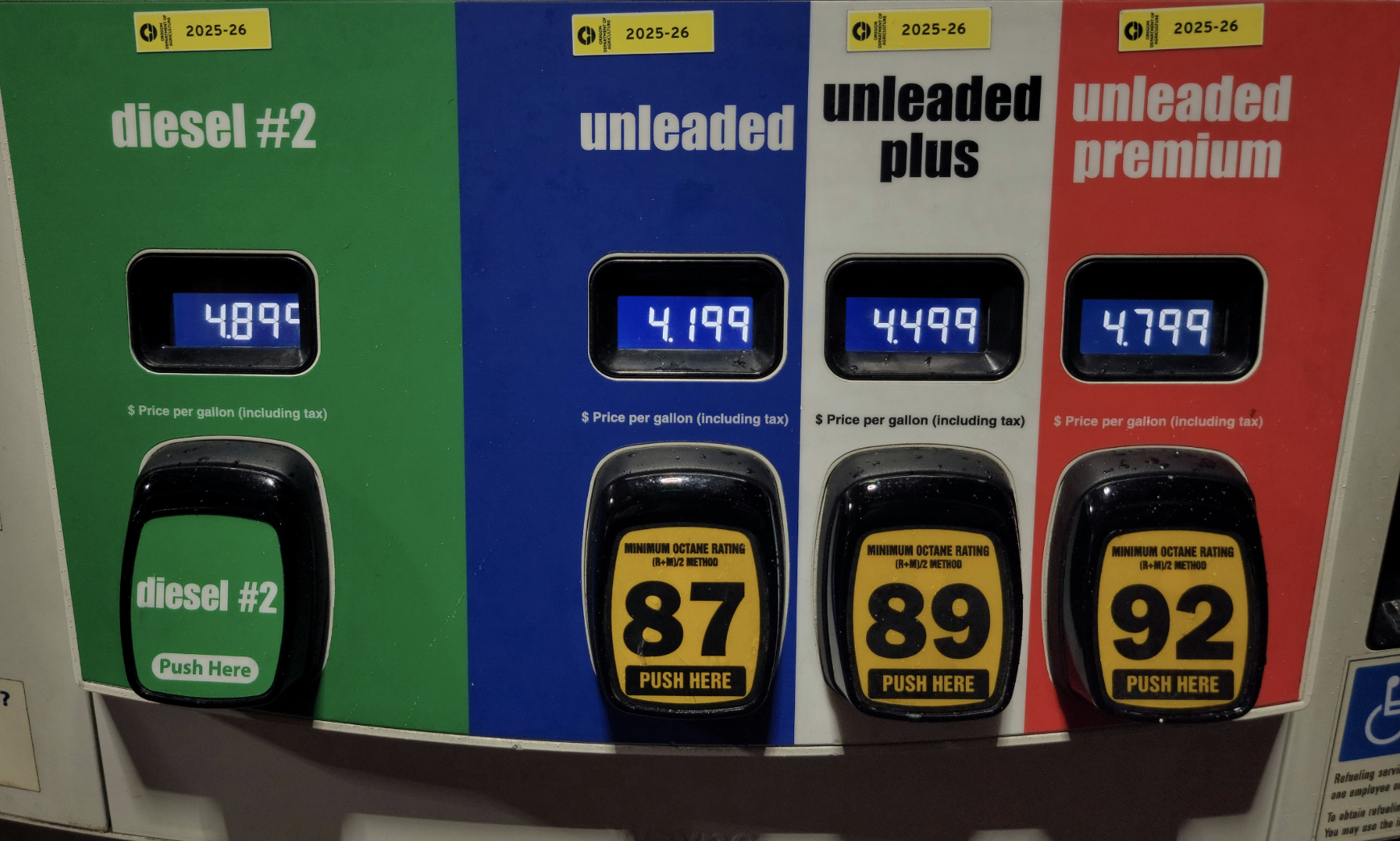
Amid skyrocketing oil prices and concerns about ordinary Americans subsidizing Big Oil’s expected superprofits at the pump, new disclosures show how the U.S. continues to inadequately tax its oil majors.
The largest U.S. oil and gas companies continue to pay substantially more tax abroad than at home, as previous FACT analysis found. Now, companies are required to reveal additional details about their taxes, pursuant to new accounting standards long advocated by investors. The new data reveals that less than 10 percent of Exxon’s total taxes paid globally in 2025 went to the federal government, while for Chevron, that figure is only two percent. Chevron paid around three times as much tax to each of Kazakhstan, Nigeria, and Saudi Arabia as to the U.S., and Exxon paid an eye-watering five times more to the United Arab Emirates than to the federal government. ConocoPhillips paid more to both Libya and Norway than to the U.S. in 2025.
Table: Income Tax Payments by American Oil and Gas Super Majors in 2025 (USD millions)
Big Oil’s low federal cash tax payments are driven in part by generous, longstanding subsidies for drilling abroad, as documented in FACT’s report, America-Last and Planet-Last. Additional lavish corporate tax breaks passed into law last summer are further reducing the effective tax rates of American oil and gas companies. For example, according to an analysis by FACT-member Institute on Taxation and Economic Policy, ExxonMobil reduced its same-year tax rate by more than half a billion dollars through bonus depreciation, the single most costly corporate tax provision in last year’s tax legislation.
Overall, the three American super majors expect to pay an average tax rate of just 6.1 percent on their domestic income in 2025, a dramatic decrease from the 10 percent average rate for those same companies between 2018 and 2024, and less than a third of the statutory 21 percent corporate tax rate. Together, these companies deferred about $1.8 billion in taxes, more than half of their collective federal liability for 2025, including through tax breaks like bonus depreciation. Even taking into account their deferred tax liabilities, the three companies still only expect to owe a total of around 14 percent in federal tax on their combined $23 billion of domestic profit in 2025.
Table: U.S. Oil and Gas Super Majors Owed Only 6 Percent in Federal Tax on Domestic Income in 2025 (USD millions)
These downward trends in corporate taxation are not limited to the supermajors: both Murphy Oil and oilfield services giant Halliburton expect to pay less than one percent in current-year taxes for 2025, and Ovintiv, Cheniere, and APA (formerly Apache) each expect a same-year tax refund on billions of dollars of pre-tax profits.
Two of those companies, APA and Cheniere, each reported major tax benefits related to legally questionable guidance issued by Treasury last year on the Corporate Alternative Minimum Tax (CAMT) – a provision of the Inflation Reduction Act of 2022 that seeks to ensure that large, profitable American companies pay at least 15 percent in federal tax on the profits that they report to shareholders. Commenting on subsequent CAMT guidance issued in early 2026, NYU Tax Law Center’s Michael Kaercher noted that “Only Congress can repeal CAMT and yet it would be surprising if this guidance leaves any meaningful CAMT revenue to collect.”
In addition to these regulatory tax breaks, Congress directly weakened CAMT for many large oil and gas companies by introducing a new carveout for “intangible drilling costs,” a category of expenses that has already received preferential tax treatment for more than a century. Devon Energy is one of several large domestic oil and gas exploration companies that expect to materially benefit from this change.
These tax cuts and subsidies benefit corporations but do nothing to lower gas prices at the pump for American consumers, because oil and gas prices are set on global commodity markets. Without a clear policy rationale, and with oil companies set to enjoy massive windfall profits as a result of the ongoing Iran conflict, there is an urgent need to eliminate costly and ineffective tax preferences for oil and gas exploration and drilling. In the short term, windfall tax proposals, such as the one recently reintroduced by Sen. Whitehouse and Rep. Khanna, would present a useful stopgap measure, and similar “solidarity contributions” have been implemented in several European countries in the wake of Russia’s invasion of Ukraine. Ultimately, however, a more comprehensive solution is to repeal all tax subsidies for the sector.