
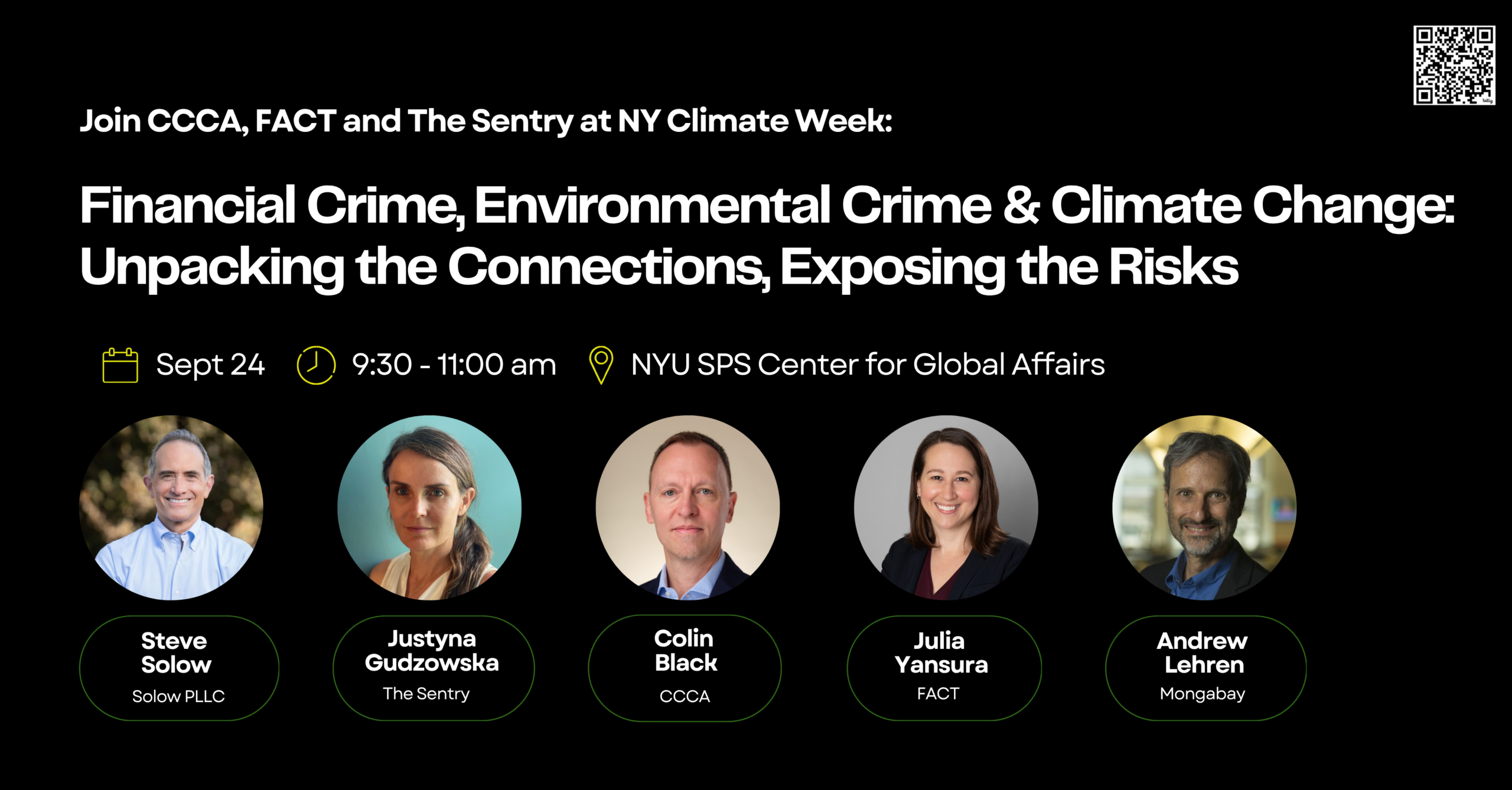
On September 24, 2026, The Sentry, the Center for Climate Crime Analysis (CCCA), and the Financial Accountability and Corporate Transparency (FACT) Coalition convened a discussion hosted by NYU’s Center for Global Affairs on the intersection of financial crime, environmental crime, and climate change.
The conversation, which was moderated by Andrew Lehren, an award-winning environmental journalist and Investigations Editor at Mongabay, explored the financial drivers of environmental crime, the risks that corporate and financial actors may be exposed to as a result, and the opportunities to use financial intelligence and anti-money laundering frameworks to identify and disrupt financial flows linked to environmental harm.
The panel emphasized that tackling environmental crime requires looking beyond the environmental damage itself to the financial networks that facilitate it—and bringing together the expertise needed to follow those financial trails. Money laundering and other financial crimes laws provide an opportunity to address the systemic dimensions and drivers of environmental crimes. Moreover, discussants noted that while many environmental crimes have only modest penalties attached (which may not address the significant financial incentives for such crimes), investigating and pursuing the associated financial crimes often mobilizes additional investigative resources and involves significantly greater sanctions.
However, not all environmental crimes constitute “predicate offences” for money laundering charges in the United States and elsewhere. While wildlife trafficking often does, others such as illegal gold mining or illegal deforestation are not in themselves offences that can form the basis of a money laundering investigation or case in the United States. While policy and legislative reform (at the state, national, and international levels) could enhance the application of financial crimes laws to these types of environmental crime, in practice those activities often involve the commission of other offences that are predicates (such as corruption or wire fraud) that can be used to bring money laundering offences to bear.
Colin Black, Executive Director of CCCA, noted that environmental crime is part of a far broader and more complex criminal economy than is often recognized, with significant climate impacts that are only beginning to come into focus. Illegal deforestation is one widespread criminal activity that has clear climate impacts, and in some contexts mainstream economic activities such as agriculture can be linked with and based on deforestation that was itself criminal. However, the climate impact of environmental crime can also go deeper. Illegal gold mining in the Amazon, for example, releases carbon stored in soils while degrading the region’s capacity to absorb future emissions. When the links between environmental crime, financial crime, and climate change remain poorly understood, this creates gaps in our response, Black concluded.
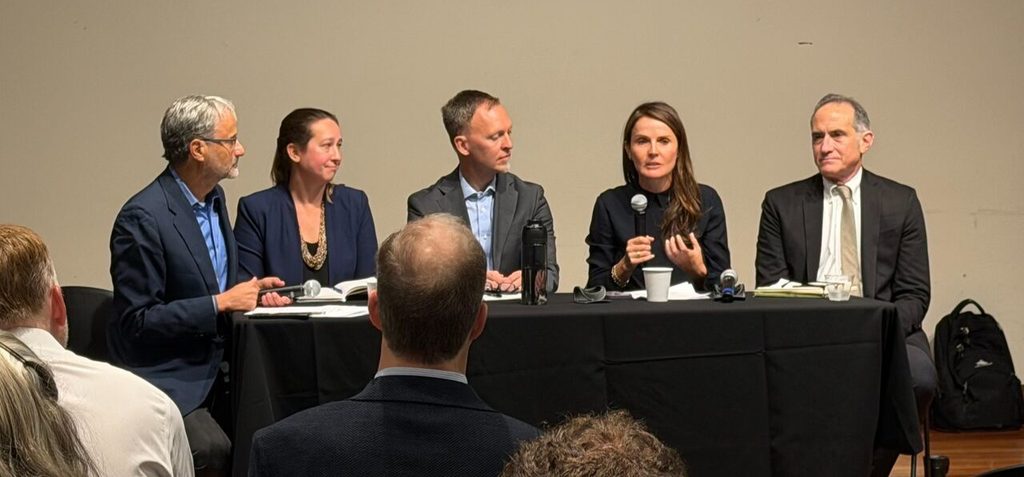
“Environmental crime often involves an element of financial crime, because of its economic motives and the large amount of illicit money channeled into our financial system. What we see now is that this combination of financial incentive and environmental harm is accelerating climate change.”
- Colin Black, CCCA
Justyna Gudzowska, executive director of The Sentry, described what it takes to investigate these cases, from following financial flows to uncovering opaque corporate structures. She noted that The Sentry did not set out to be an environmental organization. However, over the past 10 years of working to disrupt and dismantle the financial networks that enable kleptocracy, violent conflict, and terrorism, it has become clear that the illicit use of natural resources has emerged as a unifying theme.
“Some of the worst illicit actors—terrorists, transnational criminal organizations, rogue regimes and other sanctioned actors—routinely exploit natural resources to fund conflict and line their pockets. It is imperative that we not only appreciate the connection between environmental crime and national security, but that we conduct financial investigations for better accountability and safeguarding of our environment and its resilience to climate change.”
- Justyna Gudzowska, The Sentry
Julia Yansura, Program Director for Environmental Crime & Illicit Finance at the FACT Coalition, highlighted the enormous scale of illicit proceeds generated by environmental crimes such as illegal mining, noting that these activities have become major sources of criminal wealth and increasingly intersect with organized crime. Yansura underscored the exposure of financial institutions: while illicit transactions may begin with cash, barter, or cryptocurrency at the source, proceeds often enter the formal financial system as environmental commodities reach international markets. Governments, civil society, and the private sector all have a role to play in responding to these risks, with financial institutions particularly well positioned to identify suspicious transactions and generate intelligence that can support government investigations.
“When it comes to environmental crime, the financial sector is still catching up. But they’re not alone. Governments, civil society, journalists—we’re all playing catch-up with a problem that has grown far faster than our collective response.”
- Julia Yansura, The FACT Coalition
Steve Solow is the founder and Director of the Institute for Environmental Enforcement (IEE) at the Haub School of Law at Pace University. In his remarks, Solow drew on his years as a state and federal prosecutor working on organized crime and environmental cases. He noted the importance of taking a problem-solving approach to the use of criminal prosecutions when investigating environmental violations. Prosecuting one person, or even a criminal group, rarely addresses the root causes that allow the wrongdoing to occur. The EEI seeks to train a new generation of investigators and prosecutors to pursue the financial and structural support underpinning criminal activities. Solow also emphasized the importance of understanding how environmental crime affects communities, citing the problem of communities dependent upon illegal logging for sustenance and the long-term impacts of pollution events that undermine the fabric of communities. These people are also the victims of environmental crimes.
“My goal is to help develop the next generation of environmental enforcement lawyers.”
- Steve Solow, founder and Director of the Institute for Environmental Enforcement (IEE) at the Haub School of Law at Pace University
The discussion highlighted the need for greater collaboration across the financial crime, environmental, and climate fields—and for stronger tools to follow the money behind environmental harm.
About the Organizations
- The Center for Climate Crime Analysis (CCCA) combines the power of law, data & analysis to support allies fighting for climate justice and human rights, enable compliance with climate commitments, and hold accountable those causing the climate crisis.
- The Sentry is an investigative and policy organization that seeks to disable multinational predatory networks that benefit from violent conflict, repression, and kleptocracy.
- The Financial Accountability and Corporate Transparency (FACT) Coalition promotes policies to combat the harmful impacts of illicit finance on communities, global security, and the environment, and to campaign for a fair international tax system.