
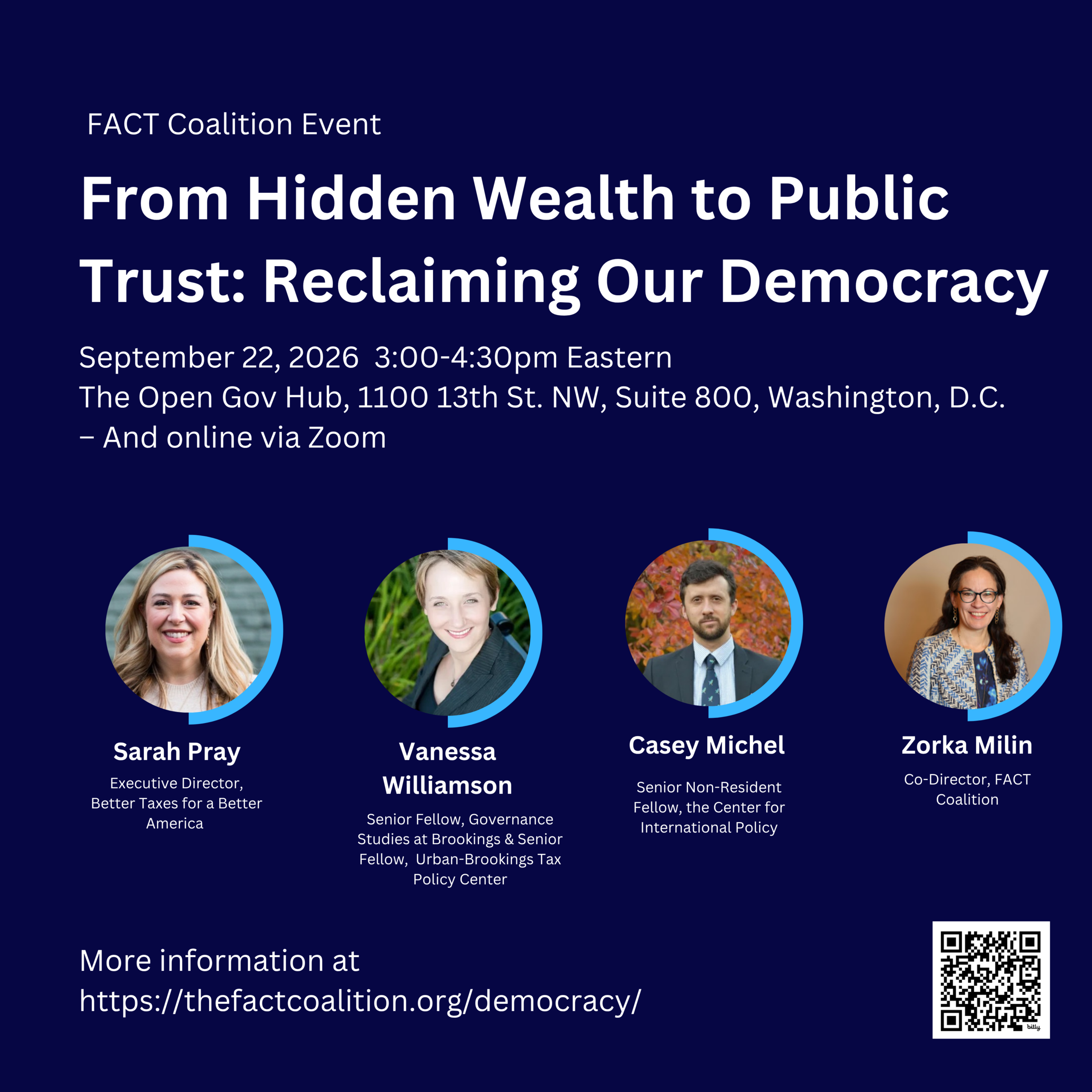
On September 22, 2026, the FACT Coalition brought policy experts, advocates, congressional staff, reporters, and funders together in Washington for a discussion about the relationship between taxation, financial transparency, concentrated wealth, and democratic accountability. The central question was how tax and financial rules affect who has access to power, who is accountable, and whether public institutions can deliver for ordinary people. Throughout the event, speakers addressed tax policy and financial transparency not just as narrow technical subjects but as visible tests of whether democratic institutions apply rules fairly and have the capacity to enforce them.
Taxation and Financial Transparency as Tools to Restore Faith in U.S. Democracy
Zorka Milin, Co-Director of the FACT Coalition, emphasized that tax and financial rules shape communities, the economy, national security, and ultimately democracy. The problem is not only whether wealthy individuals or corporations pay too little, but whether secrecy and unequal rules allow the same actors to wield money and political influence to escape public accountability. The Corporate Transparency Act and the OECD’s global corporate minimum tax serve as evidence that sustained, broad-based advocacy can produce major reforms.
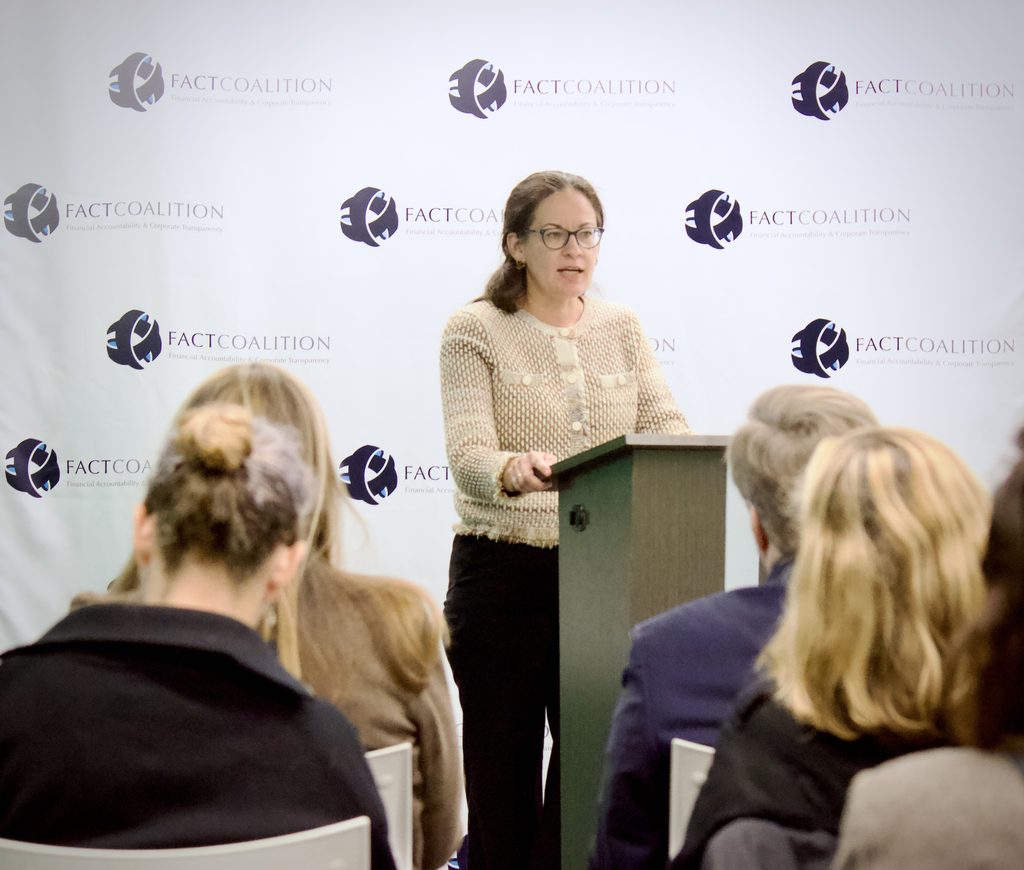
“This is about whether the wealthiest individuals, the largest corporations, and the criminally corrupt can keep evading their responsibilities, sometimes by hiding their wealth and using it to wield political power, beyond the reach of public accountability.”
- Zorka Milin, Co-Director, FACT Coalition
Sarah Pray, Executive Director of Better Taxes for a Better America, presented polling from her organization that connects public attitudes toward taxation to attitudes toward U.S. democracy. That polling shows that roughly two-thirds of Americans believe democracy is not working well for people like them, while 86 percent of voters believe wealthy individuals have too much power and influence over government.
In the same poll, 60 percent view the tax system as evidence that democracy is not working well. Pray’s argument was not that many Americans have abandoned democracy; rather, they have become less confident that government is responsive to them. The tax code makes that problem concrete because ordinary households generally pay highly visible taxes on wages, purchases, and property, while very wealthy people and large corporations can use more complicated structures to reduce their tax obligations.
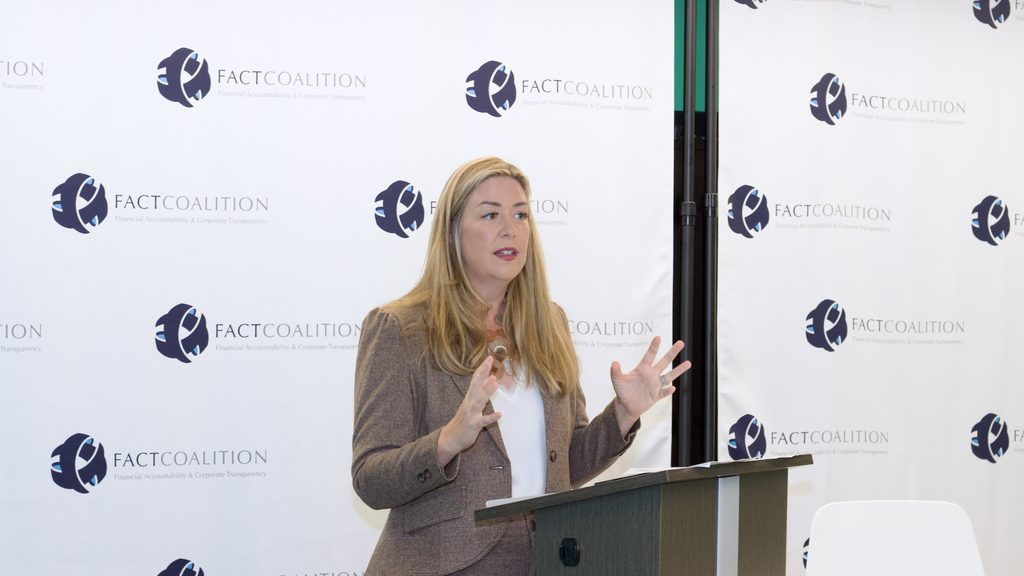
“Financial secrecy makes it harder to know who owns what, where money is moving, where profits are being reported and who ultimately benefits. It makes enforcement harder, of course. But it also makes power harder to see. And you can’t hold power accountable if you can’t see it.”
- Sarah Pray, Executive Director, Better Taxes for a Better America
That distrust has only become more commonplace in recent years. Pray cited polling in which 76 percent of voters said that Congress increasing taxes on the wealthy and large corporations would make them more confident that American democracy is working. Clearly, visible governmental action can rebuild trust. In Pray’s account, democratic institutions such as elections, courts, the press, and anti-corruption safeguards depend largely on people believing that those same institutions actually respond to them. Tax policy is simply one of the most tangible places where citizens can judge whether public rules are being drafted and applied fairly.
Vanessa Williamson: Lessons on Democracy and Taxation from U.S. History
Vanessa Williamson used lessons from U.S. history to challenge the idea that Americans are reflexively against higher taxes. She began with the Boston Tea Party, arguing that one of the most famous episodes in American history was primarily driven not by high taxation, but by anger over a discrete corporate tax break that only benefitted the East India Company. This historical event – deeply ingrained in the American psyche – was in fact an example of how taxation, fairness, and public liberty are deeply intertwined. Since the country’s founding, taxation has consistently been tied to broader struggles over democracy and private power.
According to Williamson, the strongest early American anti-tax constituency was not the Boston crowd, but slaveholders who feared mass democracy and taxation. Even a narrow version of democracy where every property-owning white man could vote would easily tax slavery out of existence, given that visible, measurable wealth was easier for the government to reach. She used that history to make the broader point that governments cannot tax what they cannot see or measure.
Williamson later traced the long political fight to establish a durable federal income tax, emphasizing that reformers continued organizing even after an earlier tax had been struck down by the Supreme Court, and ultimately succeeded in instituting the modern income tax through a constitutional amendment. These lessons from history show that, even though major tax reforms take time, they can survive intense opposition when reformers build durable, popular coalitions.
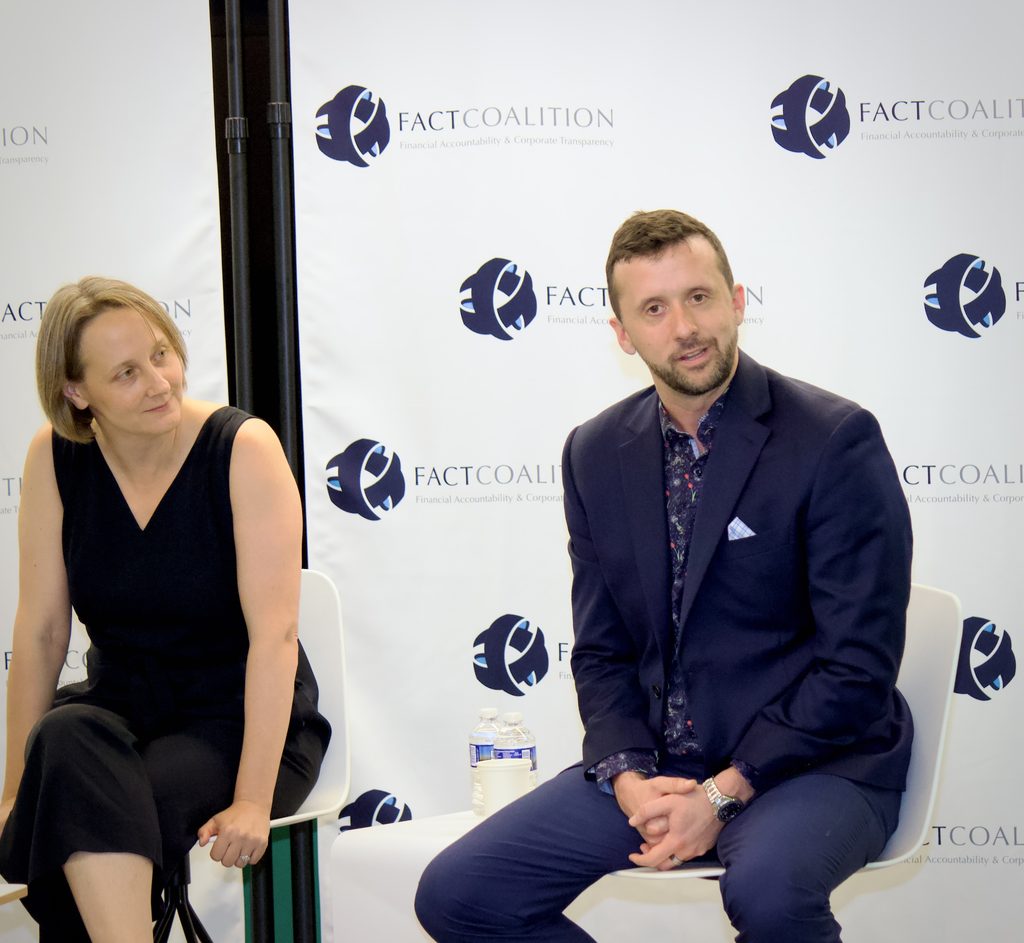
“Democracy is not just elections. Elections are obviously very, very important, but democracy is not just the fact that people have the right to vote. It is the fact that people have the power to enact what they have decided through the state.”
- Vanessa Williamson, Senior Fellow, the Brookings Institution
Casey Michel: Financial Secrecy Concentrates Wealth and Fuels Corruption
Casey Michel drew on his research on global kleptocracy and oligarchy to describe a U.S. “wealth defense industry” made up of lawyers, accountants, lobbyists, shell companies, offshore vehicles, and other services used to manage and conceal wealth. He argued that many of these tools have contributed to a transnational ecosystem of hidden money and influence.
While officials have long recognized the role this ecosystem has played in fueling corruption abroad, it is increasingly evident that U.S. “oligarchs” are relying on the same tools in ways that more directly affect American politics, elections, and democratic institutions.
Michel made it clear that secrecy itself has become a problem for democracy. While anonymity has historically served some legitimate political purposes, including protecting dissidents and writers, modern financial secrecy now prevents journalists, investigators, and the public from identifying who owns assets, where money moves, and where political influence is being exerted.
Michel described this opacity as a kind of “dark matter” in American democracy: difficult to see directly but ultimately warping elections, campaign finance, and the distribution of economic power more broadly. The practical issue remains accountability: without visibility into ownership and financial flows, citizens and watchdogs cannot effectively determine who is exercising power or challenge corruption.
On anti-corruption, “there’s more momentum and opportunity now than we’ve seen since the Watergate era, maybe ever. It’s a question of taking advantage of that opening and that opportunity.”
- Casey Michel, Senior Non-Resident Fellow, The Center for International Policy
Institutional Capacity: Laws Depend on People and Agencies
The discussion repeatedly returned to the capacity of institutions to enforce the rules that are already on the books. The gutting of the IRS through reductions in staffing and enforcement resources in particular presents a practical threat to the rule of law. While much political debate often treats “government” as an abstraction, Williamson argued that rebuilding institutions and making their work more visible will be essential to combating the public perception that laws are simply “words on paper”.
Democratic accountability, in other words, depends not only on passing laws but on providing and maintaining the resources, coordination, and administrative capacity needed to enforce them.
State Policy, National Reform, and International Lessons
In response to an audience question on whether states could serve as laboratories for reforms that were difficult to advance federally, Williamson argued that while state-level policies could play an important role in movement building and policy development, some measures ultimately need to be national to operate at sufficient scale. State and federal action are complementary, rather than mutually exclusive: state experiments can demonstrate what is possible and help build momentum for broader change.
The speakers also considered how experiences abroad could inform U.S. reform, and how institutions such as the OECD, United Nations, and Financial Action Task Force could help establish and preserve international anti-money-laundering and transparency standards. This global layer is critical because money, companies, ownership structures, and professional service providers cross national borders even when regulations do not.
“If Congress can enact broadly popular reforms despite opposition from wealthy and powerful interests, that tells people something about who has power in our democracy. If government can require powerful people and corporations to play by the same rules as everyone else, that tells people something too.”
- Sarah Pray, Executive Director, Better Taxes for a Better America
For Additional Reading
- Want People to Believe in Democracy? Tax a Billionaire
- Sarah Pray for The Hill
- Give Me Liberty and Give Me Taxes: Why Democracies Love Taxation—and Autocracies Hate It
- Vanessa Williamson for Foreign Affairs
- We’re Not In a New Gilded Age in America – Inequality is Now Far Worse
- Casey Michel for The Guardian
- How Financial Secrecy Undermines Democracy
- Charles G. Davidson & Ben Judah for the Journal of Democracy
- Charles G. Davidson & Ben Judah for the Journal of Democracy